
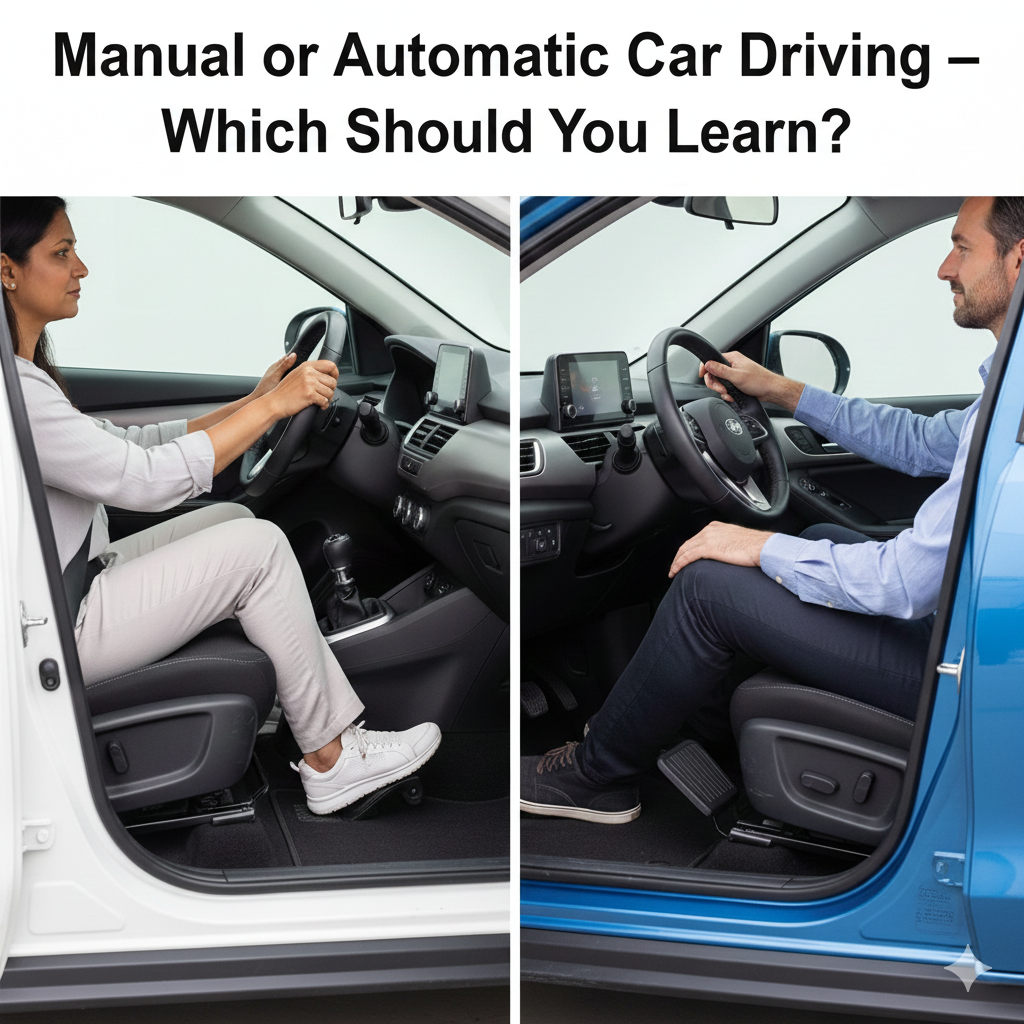
Choosing between a manual and an automatic car is an important decision for anyone learning to drive. Each type of transmission offers a different driving experience, level of control, and learning challenge.
Manual cars help drivers develop stronger vehicle control and a better understanding of how a car operates, while automatic cars are easier to learn and more convenient for everyday driving.
This blog explores whether you should learn in a manual or go for an automatic to help you make an informed choice that suits your driving needs and lifestyle.
Highlights
- A manual car requires the driver to change gears using a gear stick and a clutch pedal. You’re fully in control of when and how the gears shift.
- An automatic car changes gears on its own. You simply press the accelerator and brake. No clutch, no manual gear changes.
- Learning manual driving can improve driving skills and flexibility, while automatic driving offers comfort and ease.
- Your choice should depend on comfort, future needs, and where you plan to drive most often.
What Is a Manual Car and How Does It Work?
A manual car (also known as a stick-shift car) requires the driver to manually change gears using a gear lever and a clutch pedal. To move the car smoothly, the driver must coordinate the clutch, accelerator, and gear changes depending on speed and road conditions.
How does a Manual Transmission Work?
- The clutch pedal disconnects the engine from the wheels while changing gears.
- The driver selects the appropriate gear based on speed.
- Releasing the clutch smoothly transfers power back to the wheels.
Advantages of Learning Manual Driving
- Better understanding of how a car works.
- Greater control on steep roads and difficult terrains.
- Ability to drive both manual and automatic cars.
Challenges of Manual Driving
- Steeper learning curve.
- Requires more coordination and practice.
What Is an Automatic Car and How Does It Work?
An automatic car handles gear changes automatically, without requiring the driver to use a clutch or manually shift gears. The transmission system decides the right gear based on speed, acceleration, and engine load.
How does an Automatic Transmission work?
- The car selects gears automatically.
- The driver uses only the accelerator and brake pedals.
- Gear options usually include P (Park), R (Reverse), N (Neutral), and D (Drive).
Advantages of Learning Automatic Driving
- Easier and faster to learn.
- Allows better focus on road awareness.
- Ideal for beginners or nervous drivers.
Limitations of Automatic Driving
- Limited control in certain driving conditions.
- An automatic-only license may restrict driving manual cars
Ready to choose between manual or automatic driving? Book your professional driving lessons today and start learning with confidence from expert instructors.
Can You Drive a Manual Car After Learning in an Automatic?
In most cases, no. If you pass your driving test in an automatic car, your licence will usually be restricted to automatic vehicles only. This means you are not legally allowed to drive a manual car unless you later complete additional training and pass a manual driving test in Australia.
Can You Drive an Automatic Car After Learning Manual?
Yes, you can drive an automatic car after learning manual driving. In fact, many drivers find the transition from manual to automatic much easier than the other way around. Learning manually first gives you strong vehicle control skills, which makes driving an automatic car feel simple and stress-free.
Statistics on Learners Choosing Manual vs. Automatic
According to the Learner Driver Survey 2023, more than 70% of drivers aged 18–27 reported holding an automatic licence, highlighting a strong preference for easier-to-learn vehicles among new learners. In contrast, over 60% of male respondents held a manual licence, showing that manual driving remains more common among certain demographics. State-based differences were also evident, with nearly 60% of South Australians holding automatic licences, while Queensland and Western Australia had close to 65% of respondents holding manual licences.
The data also revealed that learners taking manual driving tests consistently achieved higher pass rates than those sitting automatic tests, despite the growing popularity of automatics. Over the past decade, particularly from 2011 to 2021, Queensland recorded a noticeable decline in manual test numbers, with automatic licence tests becoming the preferred choice. These statistics suggest that while automatic driving is increasingly popular due to ease and convenience, manual driving still offers advantages in skill development and test success, influencing some learners to choose manual for long-term flexibility.
Automatic vs. Manual: Which Transmission Should You Learn First?
For most beginners, starting with an automatic car in a beginner driving lesson is often easier and recommended, as it allows learners to focus on road rules, traffic awareness, steering, and braking without the added challenge of clutch and gear control; however, if your goal is driving in a manual-heavy field, starting with a manual offers more control and future options, despite a steeper initial learning curve. Your choice depends on your goals, confidence, and the types of cars you’ll drive.
Learn manual driving if:
- You want maximum flexibility.
- You enjoy learning driving mechanics.
- You want stronger driving skills.
Learn automatic driving if:
- You want an easier learning experience
- You feel anxious about clutch control
You may also read: What to Expect on Your First Driving Lesson?
Conclusion
Both manual and automatic cars have their own advantages, and neither option is better for everyone. Manual driving offers greater control and long-term flexibility, while automatic driving provides ease, comfort, and faster learning.
The best choice is the one that matches your confidence, lifestyle, and driving goals. With professional guidance and choosing the right driving school, you can become a safe and confident driver in either transmission.
Driving schools like Nirvana Driving offer both manual and automatic driving lessons, helping learners choose the option that suits them best and guiding them every step of the way toward safe, confident driving. Book your driving lesson with Nirvana Driving today!
FAQs
1. Can I drive an automatic car with a manual licence?
Yes, in Australia, if you hold a manual driver’s licence (Class C), you are permitted to drive both manual and automatic cars, but an automatic-only licence (Class CA) restricts you to automatic vehicles unless you upgrade by passing a manual test.
2. Can I drive a manual with an automatic licence?
No. If you hold an automatic-only licence, you are legally allowed to drive automatic cars only. To drive a manual car, you would need to take additional lessons and pass a driving test in a manual vehicle.
3. Is manual driving difficult to learn than automatic driving?
Yes, manual driving is generally more challenging to learn than automatic driving. It requires mastering clutch control, gear changes, and coordination. Automatic driving is simpler because the car changes gears for you, making it easier for beginners.
4. Can I switch from automatic to manual later?
Yes, you can switch from automatic to manual later. However, it may take extra practice to learn clutch control and gear shifting.
5. Is the learning manual still worth it today?
Yes, learning to drive a manual car is still worth it for many drivers. It gives you greater driving flexibility, stronger vehicle control, and the ability to drive both manual and automatic cars. While automatics are becoming more popular, manual skills can still be helpful for certain vehicles, regions, and driving situations.