
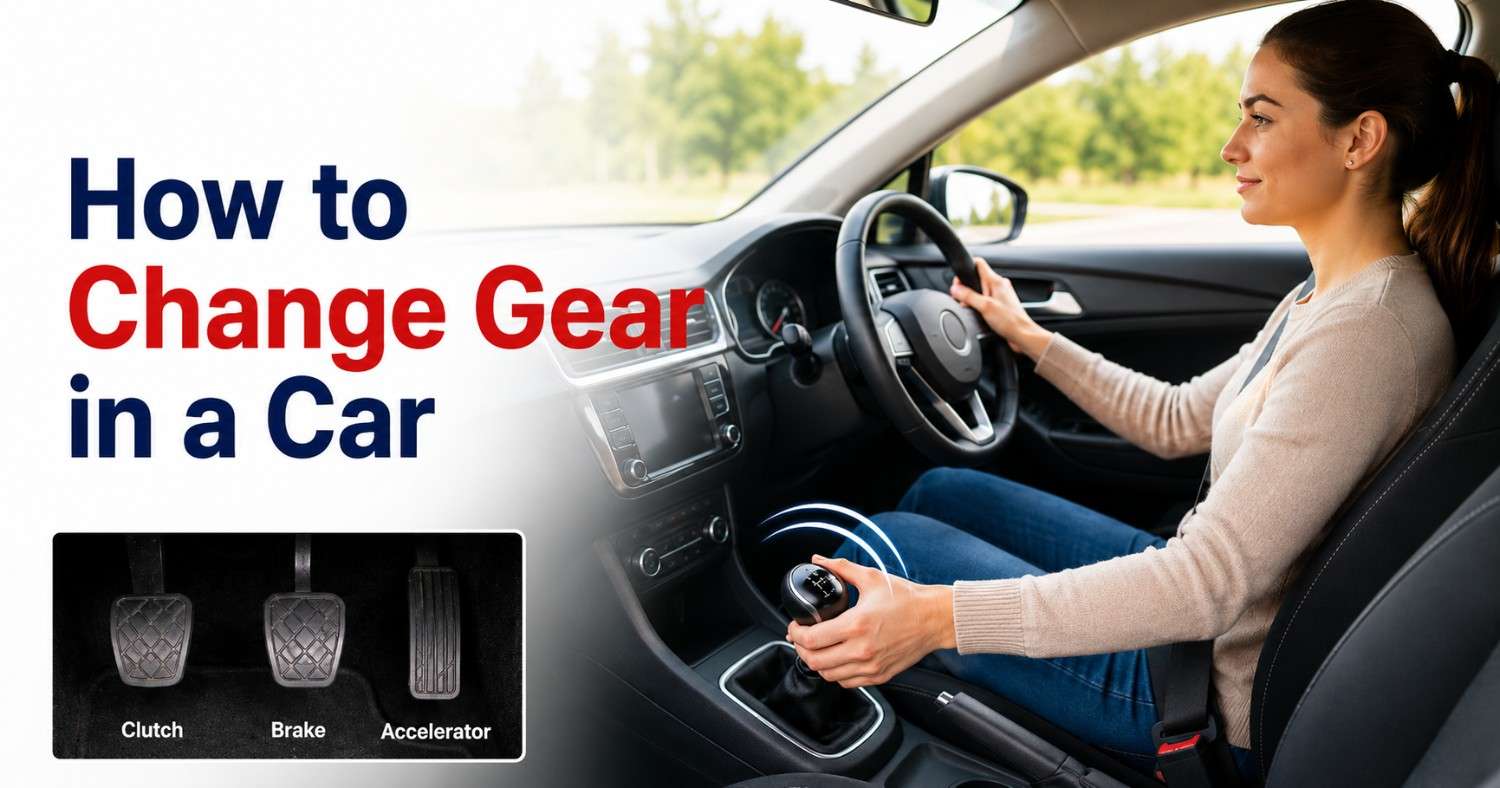
A car’s gears help control how power from the engine reaches the wheels. When the right gear is selected at the right time, the car moves more smoothly, responds better to the driver, and handles different road situations with greater control.
For new drivers, gear changing can feel a little tricky at first, especially in a manual car. You need to coordinate the clutch, accelerator, and gear lever while also watching the road. With steady practice, these movements begin to feel more natural, and the car becomes easier to manage.
In an automatic car, the process is simpler because the vehicle changes most gears by itself. The driver mainly needs to understand basic positions such as Park, Reverse, Neutral, and Drive.
This guide explains how to change gears in a car in simple steps. You will learn how to shift up, shift down, use the clutch properly, avoid common mistakes, and build smoother gear control while driving.
Key Highlights
- Changing gear helps the car use the right amount of engine power for different speeds and road conditions.
- In a manual car, smooth gear changing depends on proper control of the clutch, gear lever, accelerator, and brake.
- Lower gears give the car more power, so drivers use them when starting, slowing down, turning, climbing hills, or driving in traffic.
- Higher gears help the car move smoothly and efficiently once it gains enough speed on open roads.
- Drivers should change gears when the engine sounds too loud, the car feels weak, or the road situation requires more control.
- In an automatic car, the vehicle changes most forward gears by itself, but the driver still needs to choose the correct mode, such as Park, Reverse, Neutral, or Drive.
- Poor gear-changing habits can cause jerking, stalling, over-revving, clutch wear, and gearbox stress.
Main Parts Used When Changing Gear
The main parts used when changing gear include the clutch pedal, gear lever, accelerator, brake pedal, neutral gear, parking brake, and dashboard instruments.
1. Clutch Pedal
The clutch pedal is found in manual cars and is usually located on the far left. It is operated with the left foot. Its main role is to connect and disconnect the engine from the gearbox.
The clutch is an important part of manual driving because it allows the driver to select different gears. Without using the clutch correctly, the gearbox cannot work smoothly. The clutch also helps control the car at very low speeds, especially when moving slowly in traffic or starting on a slope.
2. Gear Lever
The gear lever, also called the gear stick or shifter, is used to select the gear. In a manual car, it usually includes gears such as 1st, 2nd, 3rd, 4th, 5th, 6th, Reverse, and Neutral. The layout can vary depending on the car model.
In an automatic car, the gear lever or gear selector usually includes positions such as Park, Reverse, Neutral, and Drive. Some automatic cars may also have extra modes such as Sport, Low, Manual, or Brake mode. These modes depend on the vehicle type and transmission design.
3. Accelerator Pedal
The accelerator pedal is usually located on the far right and is operated with the right foot. It controls the amount of power the engine produces.
When the accelerator is pressed, the engine gives more power to the vehicle. When it is released, the car gradually reduces power. The accelerator is closely linked with gear use because engine power and gear selection must match the car’s speed and driving conditions.
4. Brake Pedal
The brake pedal is used to slow down or stop the car. In a manual car, it is usually the middle pedal. In an automatic car, it is one of the two main pedals and is operated with the right foot.
The brake is important because gear choice often depends on vehicle speed. When the car slows down, a lower gear may be needed. When the car is stopped, the brake helps keep the vehicle still and under control.
5. Neutral Gear
Neutral is a position where no driving gear is selected. In a manual car, the gear lever sits in the middle position when neutral is selected. In an automatic car, Neutral is usually marked with the letter “N.”
Neutral is commonly used when the vehicle is stationary in certain situations. However, it is not meant for normal driving because the car is not connected to a driving gear while in neutral.
6. Parking Brake or Handbrake
The parking brake, also known as the handbrake, helps keep the car still when it is stopped or parked. Some cars use a traditional hand lever, while modern vehicles may have an electronic parking brake button.
The parking brake is especially useful when parking on a slope or holding the car still for a short time. It adds extra safety by preventing the vehicle from rolling when it is not being driven.
7. Dashboard Instruments
The dashboard gives the driver useful information about the car. The speedometer shows how fast the vehicle is moving, while the rev counter, also called the tachometer, shows how fast the engine is running.
These instruments help the driver understand the car’s condition while driving. They can also give useful clues about whether the engine is running smoothly, working too hard, or needing a different gear.
When to Change Gear?
You should change gears when the current gear no longer matches the car’s speed, engine sound, or driving condition. If the engine sounds too loud or the car feels like it is working too hard, it usually means you need a higher gear. If the engine feels weak, vibrates, or struggles to accelerate, a lower gear may be needed.
Gear changes are also needed when the road situation changes. For example, you may need a lower gear when slowing down, turning, driving uphill, moving through traffic, or preparing to stop. On faster, open roads, higher gears help the car move more smoothly and efficiently.
You may also read: What Is the Best Car for a Learner Driver?
How to Change Gear in a Manual Car?
To change gear in a manual car, ease off the accelerator, press the clutch fully, select the correct gear, then release the clutch smoothly while gently pressing the accelerator. Making smooth, controlled movements helps prevent jerking or stalling and ensures safer, more comfortable driving.
1. Ease Off the Accelerator
Before changing gear, gently lift your foot from the accelerator. This reduces engine power and prepares the car for a smooth gear change. If you keep pressing the accelerator while changing gear, the engine may rev too much.
2. Press the Clutch Fully
Press the clutch pedal fully down with your left foot. This separates the engine from the gearbox for a short time. It allows you to move the gear stick without forcing it. A half-pressed clutch can make the gear change rough.
3. Select the Correct Gear
Move the gear stick into the gear that matches your speed and road conditions. Use a higher gear when the car gains speed. Use a lower gear when the car slows down or needs more power. Do not rush or force the gear stick.
4. Release the Clutch Slowly
After selecting the gear, lift your foot from the clutch slowly. A smooth clutch release helps the car stay steady. If you release the clutch too quickly, the car may jerk or stall.
5. Press the Accelerator Gently
Once the clutch starts to release, press the accelerator gently. This gives the car power again and helps it continue moving smoothly. Avoid pressing too hard, especially as a beginner.
6. Keep Your Movements Smooth
Good gear changing depends on timing and control. Press the clutch fully, move the gear stick gently, and release the clutch with care. With practice, your gear changes will feel smoother and more natural.
Struggling with gear changes?
Learn how to shift smoothly, control the clutch, and drive with more confidence.
Book a LessonHow to Change Gear in an Automatic Car?
Changing gear in an automatic car is simpler than in a manual car because there is no clutch pedal. The car changes forward gears by itself while you drive. Your main job is to choose the correct gear mode before moving, reversing, parking, or driving on special road conditions.
1. Use Park Before Starting or Leaving the Car
Park mode is marked as P on the gear selector. You use it when the car is stopped and parked. It helps keep the car from moving. Most automatic cars should be in Park before starting the engine or turning it off.
2. Select Drive for Normal Forward Driving
Drive mode is marked as D. You use it when you want the car to move forward. Once you select Drive, the automatic gearbox chooses the right gear as your speed changes. This makes normal driving easier because you do not need to shift through each gear yourself.
3. Use Reverse Only When Moving Backward
Reverse mode is marked as R. You use it only when you need to move the car backward. The car should come to a full stop before you select Reverse. This helps protect the gearbox and keeps the car under control.
4. Use Neutral Only When Needed
Neutral mode is marked as N. In Neutral, the engine runs, but the car does not send power to the wheels. Drivers may use Neutral in limited situations, such as when the car needs to be moved without engine power. It is not the main driving mode for normal road use.
5. Use Sport Mode for Stronger Response
Some automatic cars have S mode, which means Sport. This mode lets the car hold lower gears for longer and gives stronger acceleration. It can make the car feel more responsive, but it may use more fuel than normal Drive mode.
6. Use Low Gear or B Mode on Slopes
Some automatic cars have L, 1, 2, or B mode. These modes help the car stay in a lower gear. They can help when driving uphill, downhill, or on steep roads. A lower gear gives better control and reduces the need for heavy braking on long descents.
7. Press the Brake Before Changing Main Modes
In most automatic cars, you should press the brake pedal before shifting from Park to Drive or Reverse. This prevents sudden movement and gives you better control. You should also keep the car fully stopped before changing between Drive, Reverse, and Park.
8. Avoid Changing to Park or Reverse While Moving
Do not shift into Park or Reverse while the car is still moving forward. This can damage the transmission and create a safety risk. Always stop the car first, then select the correct mode.
You may also read: How to Drive an Automatic Car?
Common Gear-Changing Mistakes
Many learner drivers make gear-changing mistakes because they rush the clutch, choose the wrong gear, or use the accelerator too sharply. These mistakes can make the car jerk, stall, lose power, or feel hard to control. They can also put extra stress on the clutch and gearbox over time.
1. Releasing the Clutch Too Quickly
Releasing the clutch too fast is one of the most common mistakes in a manual car. It can make the car jump forward, jerk, or stall. A smooth clutch release helps the engine power connect to the wheels without sudden movement.
2. Not Pressing the Clutch Fully
Some drivers press the clutch only halfway before moving the gear stick. This can make the gear feel hard to select. It may also cause a grinding sound. Pressing the clutch fully gives the gearbox enough space to change gears smoothly.
3. Choosing the Wrong Gear
The wrong gear can make the car feel weak, noisy, or unstable. A high gear at low speed can make the engine struggle. A low gear at high speed can make the engine rev too loudly. The right gear should match your speed, road conditions, and engine response.
4. Pressing the Accelerator Too Hard
Too much accelerator after a gear change can make the engine rev loudly and cause rough movement. This often happens when learners panic or try to move off too quickly. Gentle pressure gives better control and helps the car move smoothly.
5. Shifting Up Too Early
Shifting up too early can make the car lose power. The engine may feel weak because the car has not gained enough speed for the higher gear. This often happens on hills, in traffic, or when moving from first to second gear too soon.
6. Shifting Down Too Late
Shifting down too late can make the car shake, struggle, or stall. This happens when the car slows down but stays in a gear that is too high. A lower gear gives the car more control at slower speeds.
7. Resting Your Foot on the Clutch
Keeping your foot on the clutch while driving can wear the clutch faster. Even light pressure can affect the clutch system. After changing gear, place your left foot away from the clutch pedal.
8. Resting Your Hand on the Gear Stick
Some drivers keep one hand on the gear stick while driving. This may feel normal, but it can put pressure on gearbox parts. Keep both hands on the steering wheel unless you need to change gear.
9. Holding the Car on a Hill With the Clutch
Using the clutch to stop the car from rolling on a hill can cause extra clutch wear. It also makes the car harder to control. Use the brake or handbrake when you need to stay still on a slope.
10. Looking Down at the Gear Stick
Looking at the gear stick while driving takes your eyes off the road. This can be risky, especially in traffic or near junctions. Learners should practise the gear pattern while parked so they can change gear by feel.
11. Forcing the Gear Stick
Forcing the gear stick can damage the gearbox and make gear changes rough. If the gear does not select smoothly, the clutch may not be fully pressed, or the car speed may not match the gear. A smooth gear change should not need force.
You may also read: Manual vs. Automatic – Which Car Driving Should You Learn?
Conclusion
Changing gear becomes easier when you understand how the clutch, gear stick, accelerator, and brake work together. In a manual car, smooth timing helps you shift up, shift down, avoid stalling, and keep better control in traffic, hills, and turns. In an automatic car, choosing the right mode also supports safe and easy driving.
If you want to build confidence and prepare for your driving test, Nirvana Driving can help with proper guidance and practical driving lessons. You can learn the right gear-changing techniques step by step. With regular practice, you can improve clutch control, understand gear timing, drive more smoothly in real road conditions, and feel more ready to pass your driving test. Book your driving lesson with Nirvana Driving today!
FAQs
1. Why does my car jerk when I change gears?
Your car may jerk if you release the clutch too quickly, press the accelerator too hard, or choose the wrong gear. Smooth clutch release and gentle acceleration can help reduce jerking.
2. What does neutral gear do?
Neutral means no driving gear is selected. In neutral, the engine can run, but power does not go to the wheels. Drivers usually use neutral when the car is stopped in certain situations.
3. Why should I avoid resting my foot on the clutch?
Resting your foot on the clutch can cause extra clutch wear. Even light pressure can affect the clutch system. After changing gear, keep your left foot away from the clutch pedal.
4. What gear should I use when driving uphill?
Use a lower gear when driving uphill because the car needs more power. If the engine feels weak or the car struggles, shift down to a suitable lower gear.
5. How can I improve my gear changing?
You can improve gear changing with regular practice, smooth clutch control, and proper accelerator timing. Driving lessons from Nirvana Driving can also help you learn safe gear control in real road conditions.