
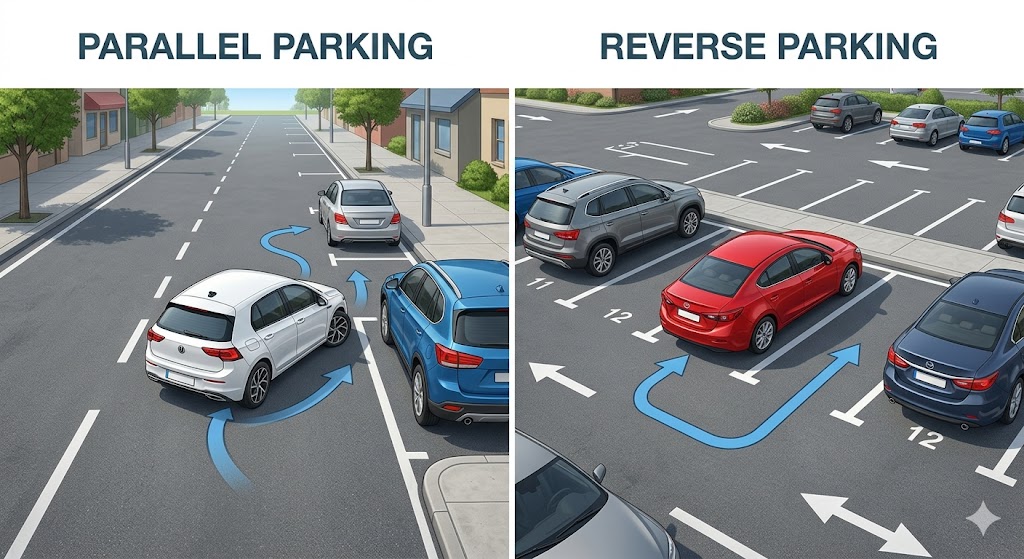
Learning how to park properly is one of the most important skills for any new driver, yet many learners often get confused between parallel parking and reverse parking. While both techniques require patience, vehicle control, and good observation, they are not the same. Each type of parking is used in different situations and comes with its own challenges.
Understanding the difference between parallel parking and reverse parking can help new drivers feel more confident, improve safety, and prepare better for real-world driving situations.
In this guide, we will explain what parallel parking and reverse parking mean, how they differ, and whether parallel parking and reverse parking are the same.
Highlights
- Parallel parking is the method of parking a car parallel to the curb or side of the road, usually between two vehicles.
- Reverse parking means parking a car by moving it backward into a parking space.
- Parallel parking and reverse parking differ in the way the vehicle is parked. Parallel parking is done by placing the car parallel to the roadside, while reverse parking is done by moving the car backward into a parking slot.
What Is Parallel Parking?
Parallel parking is a parking technique in which a driver parks the vehicle parallel to the curb or side of the road, usually between two parked cars. It is most commonly used on busy streets, in residential areas, and in places where parking spaces are available along the roadside instead of in marked bays. To do it correctly, the driver must carefully reverse the car into the space while judging distance, steering angle, and surrounding traffic.
What Is Reverse Parking?
Reverse parking is a parking method in which a driver backs the vehicle into a parking space instead of driving forward. It is commonly used in parking lots, shopping centers, office buildings, and residential complexes where marked parking bays are available. In this technique, the driver positions the car near the parking slot and then carefully reverses into it while using mirrors, observation, and steering control.
What Is the Difference Between Parallel Parking and Reverse Parking?
The key difference between parallel parking and reverse parking lies in the parking position and method. In parallel parking, the vehicle is parked next to the curb, while in reverse parking, the vehicle is backed into a marked parking space.
| Aspects | Parallel Parking | Reverse Parking |
| Parking position | The car is parked parallel to the curb or roadside | The car is parked by reversing into a parking bay or slot |
| Common Locations | Urban streets, busy roadsides | Malls, office lots, apartment complexes |
| Steering Technique | Requires a sharp “S” turn maneuver | Requires a steady “L” shaped arc |
| Space Type | A narrow gap between two vehicles | A designated, marked rectangular stall |
| Difficulty Level | Higher requires precise spatial judgment | Lower, focuses on alignment between lines |
| Exit Strategy | Must steer out into active traffic | Allows for a safer, forward-facing exit |
Now, let’s look at each aspect in detail:
Parking Position
The most basic difference between these two methods is the final position of the vehicle. In parallel parking, the car is parked horizontally along the curb or roadside, usually in line with other parked vehicles. In reverse parallel parking, the vehicle is backed into a designated bay or slot, where it is positioned either at a right angle or at a slight angle, depending on the parking layout.
Common Location
Parallel parking is commonly found on urban streets and busy roadsides where off-street parking is limited. Meanwhile, reverse parking is more common in organized areas such as shopping malls, office parking lots, and apartment complexes where spaces are clearly marked.
Vehicle Movement
Parallel parking usually involves a sharper “S” turn, where the driver must carefully time the steering and counter-steering to fit the car into a tight side space. On the other hand, reverse parking follows a steadier turning arc, allowing the driver to guide the vehicle smoothly into the center of a parking stall.
Space Type
Parallel parking is generally done in a narrow gap between two parked cars along a roadside curb, often without any painted guidelines. In contrast, reverse parallel parking takes place in a clearly marked rectangular stall, where painted lines help the driver judge position and alignment more easily.
Difficulty Level
For many drivers, parallel parking is the more difficult of the two. It requires precise spatial judgment and careful control of the vehicle in active traffic conditions. Reverse parking is generally easier because the driver mainly focuses on keeping the vehicle aligned between two visible lines.
Conclusion
In conclusion, parallel parking and reverse parking are both important driving skills, but they are not the same. Parallel parking is usually done along the roadside, where the driver must fit the vehicle into a narrow space beside the curb. Reverse parking, on the other hand, involves backing the vehicle into a marked bay or parking slot. Since each method is used in different situations, both require different levels of steering control, space judgment, and confidence.
For beginner drivers, understanding the difference between these two parking techniques is an important step toward developing safer and smarter driving habits. Learning both skills properly not only improves parking ability but also builds overall driving confidence. At Nirvana Driving, learners can develop confidence in both parallel parking and reverse parking through clear instruction and guided practice. With the right training and regular practice, drivers can handle different parking situations more safely and comfortably in everyday driving. Call 045-053-0126 or book your driving lesson online with Nirvana Driving!
Frequently Asked Questions
Why do driving instructors teach reverse parking before parallel parking?
Driving instructors teach reverse parking before parallel parking because it helps beginners build core parking skills in a simpler, more controlled environment. With clear lines and a fixed space, learners can improve spatial awareness, steering control, and mirror use before moving on to the more challenging parallel parking maneuver.
Can small cars and large cars require the same parking technique?
Yes, both small and large cars use the same basic parking techniques, but the amount of space and turning control may vary. Larger vehicles often need more careful judgment, while smaller cars are easier to position in tighter spaces.
How can I improve my parking accuracy as a beginner?
Parking accuracy improves with slow movement, regular practice, and proper use of mirrors and reference points. With expert guidance from Nirvana Driving, practicing in a quiet area can help learners better understand spacing, timing, and vehicle control with more confidence.
Is it normal to feel nervous while parking in public places?
Yes, it is completely normal for beginner drivers to feel nervous when parking in busy or public areas. Confidence usually improves over time as you gain more experience and become familiar with vehicle control.
Do weather conditions affect parking performance?
Yes, the weather can make parking more challenging. Rain, fog, or poor visibility can affect mirror use, road grip, and judgment, so drivers need to move more carefully and allow extra time while parking.