
Driving in Melbourne comes with a few road rules that can seem unfamiliar to new and overseas drivers. Among them, hook turns are often considered one of the most unique and misunderstood traffic maneuvers you’ll encounter, particularly in the CBD and around tram routes.
Because hook turns are different from conventional turning methods, many learner drivers feel uncertain when approaching an intersection where one is required. Understanding when a hook turn applies, how it works, and the correct way to navigate it is essential for both road safety and driving test preparation.
This guide covers everything you need to know about hook turns in Melbourne. You’ll learn why they exist, where they’re used, how to perform one correctly, when to complete the turn, and the common mistakes to avoid.
Key Highlights
- A hook turn is a maneuver where you turn right from the far-left lane. It is primarily used in Melbourne, Australia, to allow trams to pass without being blocked by right-turning vehicles.
- Melbourne uses hook turns mainly to keep tram tracks and busy centre lanes clear.
- Drivers must follow signs such as “Right Turn from Left Only” where hook turns are required.
- A hook turn is completed only when the traffic lights on the road you are turning into change to green, and it is safe to move.
- Common learner mistakes include turning too early, forgetting to indicate, blocking pedestrian crossings, and not checking for cyclists or e-scooter riders.
What Is a Hook Turn?
A hook turn is a way of turning right from the left side of the road at specific intersections. Unlike a conventional right turn, drivers begin the manoeuvre from the far-left lane rather than the right-turn lane.
Hook turns are used at selected intersections in Melbourne and are typically indicated by signs such as “Right Turn from Left Only”. While they may seem unusual at first, they are standard road rules that drivers must follow wherever they are signposted.
Why Does Melbourne Have Hook Turns?
Melbourne has one of the largest tram networks in the world, and hook turns were introduced to keep intersections running smoothly where trams share the road with other traffic.
One of the main benefits is improved public transport efficiency. Research shows that hook turns can save trams around 11 to 15 seconds per intersection, which helps improve reliability across the entire network. Over multiple intersections, this creates significant time savings for public transport operations.
Hook turns are also designed to reduce congestion by removing turning vehicles from the right lane. This allows through traffic and trams to continue moving without delay, especially in busy areas such as Melbourne’s CBD.
Today, there are around 49 hook turn locations across Melbourne, mainly along major tram corridors like Swanston Street, Collins Street, and Bourke Street.
How do Hook Turns Work in Melbourne?
Hook turns in Melbourne operate as a controlled intersection design that separates turning vehicles from through traffic. The movement is structured so that right-turning vehicles do not interfere with trams, pedestrians, or vehicles continuing straight through the intersection.
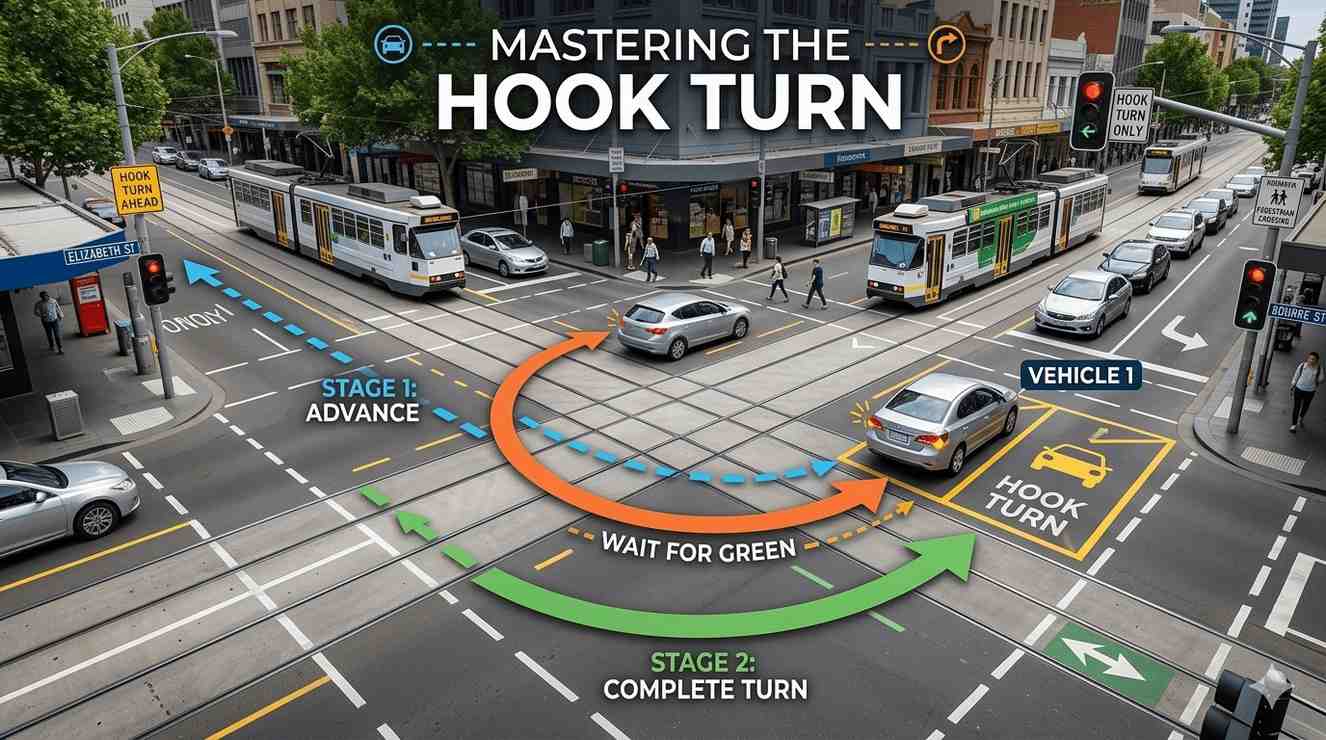
Instead of completing a right turn in a single movement, traffic is managed in two stages. Vehicles enter the intersection from the left side and pause within a designated waiting position while other road users continue to pass through.
When Do You Need to Do a Hook Turn?
You only need to perform a hook turn at intersections where it is specifically required. These locations are clearly marked with road signs such as “Right Turn from Left Only”, which indicate that a standard right turn is not allowed.
Hook turns are most commonly required in Melbourne’s CBD and at intersections with tram lines, where turning from the right lane would interfere with trams or block traffic flow. However, they can also appear at some busy intersections even without tram tracks if traffic management requires it.
If there is no hook turn sign present, you should complete a normal right turn instead. It is important to follow the posted signage at each intersection, as the rule only applies where it is explicitly indicated.
How to Do a Hook Turn?
To do a hook turn, move into the far-left lane when the intersection is signposted, indicate right, and enter the intersection on a green light while staying clear of pedestrian crossings. Wait until the lights on the road you are turning into change to green, then check for pedestrians, cyclists, e-scooter riders, trams, and other vehicles before turning right safely.
Step 1: Move into the Left Lane
Approach the intersection in the far-left lane, as required for hook turns. Check for signs indicating “Right Turn from Left Only”.
Step 2: Indicate Your Intentions
Turn on your right indicator to show you intend to make a right turn at the intersection.
Step 3: Enter the Intersection on Green
When the traffic light is green, proceed straight into the intersection from the left lane and move forward into the designated waiting position. Stay clear of pedestrian crossings.
Step 4: Stop and Wait Inside the Intersection
Remain stationary inside the intersection while through traffic, trams, and pedestrians continue to pass. Keep your vehicle straight and do not block crossing paths.
Step 5: Watch the Signal for the Road You Are Turning Into
Focus on the traffic light of the road you are turning into. You must wait until it turns green before completing the turn.
Step 6: Complete the Turn Safely
When the destination road has a green light, and it is safe to proceed, complete the right turn. Check for pedestrians, cyclists, and vehicles before moving.
Feeling nervous about hook turns or busy Melbourne intersections?
Learn how to handle hook turns, tram roads, and test routes with confidence.
Common Hook Turn Mistakes Learners Make
Common hook turn mistakes include turning too early, forgetting to indicate right, blocking pedestrian crossings, and waiting in the wrong position. Learners should also avoid rushing, copying the car in front, missing hook turn signs, or failing to check for cyclists, e-scooter riders, trams, and other vehicles.
1. Turning Too Early: One of the most common mistakes is turning right as soon as the car enters the intersection. In a hook turn, you must wait until the traffic lights on the road you are entering change to green before completing the turn.
2. Forgetting to Indicate Right: Some learners forget to signal because they are moving into the left lane first. Even though your car is positioned on the left, you are still turning right, so your right indicator should be used.
3. Blocking the Pedestrian Crossing: Stopping at the pedestrian crossing can create problems for people walking across the road. Always position your car so pedestrians have a clear and safe path.
4. Waiting in the Wrong Position: Learners may stop too far forward, too far across, or at an awkward angle inside the intersection. Try to stay in the marked hook-turn area or as far left as practical while keeping the car controlled.
5. Not Checking for Cyclists and E-Scooter Riders: Cyclists and e-scooter riders may be travelling beside you or moving through the intersection. Before completing the turn, check carefully so you do not cut across their path.
6. Rushing Because of Traffic Behind You: New drivers often feel pressured when other vehicles are waiting behind them. Stay calm and follow the traffic lights, signs, and road markings instead of rushing the turn.
7. Copying the Car in Front: Another mistake is simply following the car ahead without checking the lights or surroundings. Each driver must make sure it is safe and legal before completing their own turn.
8. Ignoring Hook Turn Signs: Some learners miss the sign and prepare for a normal right turn from the wrong lane. Always scan for signs early when driving in Melbourne’s CBD or near tram corridors.
Conclusion
Hook turns are one of the most unique road rules in Melbourne, and while they may feel confusing at first, they become much easier once you understand how they work. The key is remembering that you are not turning immediately, you are entering the intersection, waiting for the correct signal, and then completing the turn safely.
If you want to not just understand hook turns but also feel confident enough to handle them in real traffic and during your driving test, structured practice makes a big difference. Nirvana Driving helps learners develop clear, practical driving skills so manoeuvres like hook turns become simple and test-ready rather than stressful. With the right preparation, you can approach your driving test with more confidence and focus on safe decision-making instead of uncertainty at complex intersections. Book your driving lessons with Nirvana Driving today!
Frequently Asked Questions
1. Are hook turns in the driving test?
In Victoria, Australia (including Melbourne VicRoads tests), hook turns can be part of the driving test if they appear on the test route. If you are tested in another part of Australia or overseas, hook turns are generally not included as part of the driving assessment.
2. Do cyclists and e-scooter riders use hook turns?
Yes, cyclists and e-scooter riders can use hook turns at many intersections. Drivers should check carefully for them before completing the turn, especially in Melbourne’s CBD and inner suburbs.
3. Are hook turns only in Melbourne?
Hook turns are mainly used in Melbourne due to its extensive tram network. However, similar two-stage turning systems exist in other countries, even though they are not commonly used in most Australian cities.
4. What happens if you do a hook turn wrong?
If you do a hook turn incorrectly, you may receive a fine, demerit points, or create a dangerous situation for other road users. It can also affect your driving test results if it happens during the assessment.
5. How many cars can do a hook turn?
More than one car can enter the intersection for a hook turn, but each vehicle must wait its turn and complete the manoeuvre one at a time when it is safe and legally allowed.
6. What is the point of a hook turn?
The point of a hook turn is to keep right-turning vehicles out of the centre lanes. This helps trams and through-traffic move more smoothly through busy Melbourne intersections.
7. When can you complete a hook turn?
You can complete a hook turn when the traffic lights on the road you are turning into change to green, and it is safe to move.