
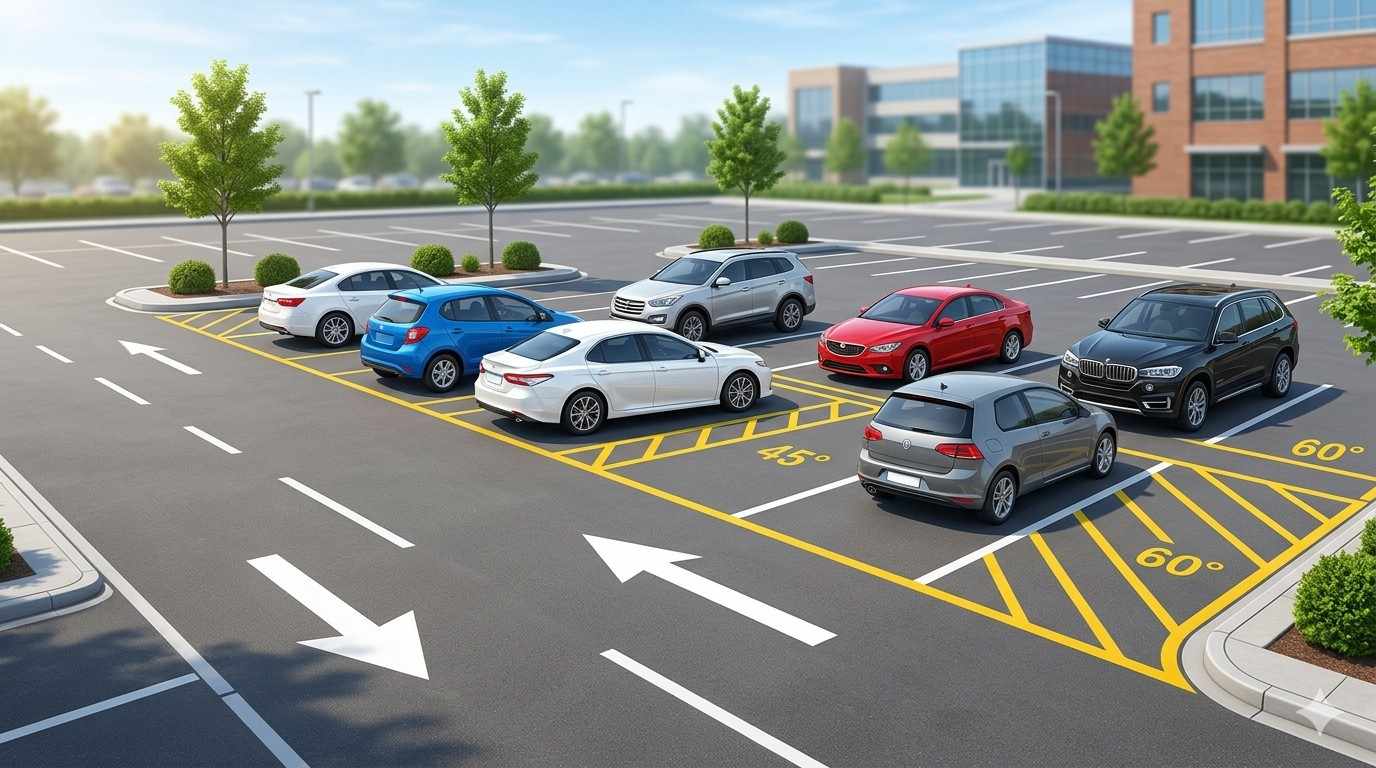
Finding a parking space is one thing, but parking correctly and safely is another. Among the various parking methods used on roads and in parking lots, angle parking is one of the most common because it allows vehicles to enter parking spaces with relative ease while helping maintain a smooth flow of traffic.
Whether you’re a new driver learning essential parking skills or an experienced motorist looking to understand parking regulations, knowing how angled parking spaces work can make parking safer and more efficient.
In this guide, you’ll learn what angle parking is, how it differs from parallel and perpendicular parking, and how to do angle parking.
Key Highlights
- Angle parking means parking a vehicle diagonally to the kerb, road edge, wall, or marked parking lines.
- Common angle parking layouts include 30-degree, 45-degree, 60-degree, and 90-degree parking.
- Some locations require nose-in parking, while others may allow or require rear-in angle parking.
- Drivers should always follow parking signs, road markings, arrows, and local parking rules.
- Safe angle parking requires slow speed, proper positioning, mirror checks, and awareness of pedestrians, cyclists, and nearby vehicles.
- Angle parking is commonly used in car parks, shopping centres, commercial streets, schools, hospitals, and public parking areas.
What Is Angle Parking?
Angle parking is a parking method where vehicles are parked diagonally to the kerb, road edge, wall, or marked parking lines. Instead of parking parallel to the road, the vehicle is positioned at an angle, commonly around 30 degrees, 45 degrees, 60 degrees, or 90 degrees, depending on the layout of the parking area.
This type of parking is commonly used in car parks, shopping centres, commercial streets, schools, hospitals, and other public areas where vehicles need to be arranged in an organised way. The exact angle and parking direction are usually shown by road markings, bay lines, or parking signs.
In some locations, drivers may be required to park nose-in, while in others, rear-in angle parking may be allowed or required. Because these rules can vary by area, drivers should always follow the signs and markings provided at the parking location.
What are the Types of Angle Parking?
Angle parking can be divided into different types, including 30-degree, 45-degree, 60-degree, and 90-degree parking. Some areas may also use nose-in or rear-in angle parking, depending on local road rules and parking signs.
1. 30-Degree Angle Parking
30-degree angle parking uses a smaller parking angle, making it suitable for areas with limited space or narrower traffic lanes. Because the vehicle is positioned at a shallow angle, it can be easier to enter and leave the parking bay in low-speed areas.
2. 45-Degree Angle Parking
45-degree angle parking is one of the most common types of angle parking. It provides a good balance between easy vehicle positioning and efficient use of parking space. This layout is often used in public car parks, shopping areas, and commercial streets.
3. 60-Degree Angle Parking
60-degree angle parking positions vehicles more sharply than 45-degree parking. It can allow more vehicles to fit into a parking area, but it usually requires more space for vehicles to move safely in and out of the parking bays.
4. 90-Degree Angle Parking
90-degree angle parking is also known as perpendicular parking or right-angle parking. In this layout, vehicles are parked straight into the bay at a right angle to the traffic lane. It is commonly used in car parks, supermarkets, office buildings, and residential parking areas.
5. Nose-In Angle Parking
Nose-in angle parking means the front of the vehicle faces the kerb, wall, or end of the parking bay. This type is commonly used where signs or markings require drivers to enter the bay front-first.
6. Rear-In Angle Parking
Rear-in angle parking means the driver reverses into the parking bay so the rear of the vehicle faces the kerb or end of the space. This type may be required in some areas because it allows the driver to leave the parking space facing forward.
Master Angle Parking with Confidence
Book a professional driving lesson and learn how to enter angled parking bays.
Book Your Lesson TodayHow to do Angle Parking?
Angle parking should be done slowly, carefully, and according to the signs or markings at the parking area. Before entering any angled parking space, check whether the bay requires nose-in parking, rear-in parking, or a specific parking angle such as 45 degrees, 60 degrees, or 90 degrees.
Step 1: Check the Signs and Road Markings
Before choosing a space, look for parking signs, painted bay lines, arrows, and any instructions such as “Nose In” or “Rear In.” These signs tell you how the vehicle should be positioned. If the area has marked lines, your vehicle should follow the angle of those lines.
Step 2: Choose a Suitable Parking Space
Select a space that gives you enough room to enter safely. Avoid very tight spaces if you are not confident, especially when there are large vehicles parked beside the bay. Make sure the space is clear of pedestrians, cyclists, shopping trolleys, and other obstacles.
Step 3: Slow Down and Signal
As you approach the parking space, slow your vehicle to a safe and controllable speed. Check your centre mirror, side mirrors, and surrounding traffic. Signal if required so other road users know you are preparing to park.
Step 4: Position Your Vehicle Correctly
Move your vehicle slightly away from the parked cars, so you have enough space to turn into the bay. Keep your speed low and line up your vehicle with the angle of the parking space. Good positioning before turning makes it easier to enter the bay without crossing the lines.
Step 5: Turn Smoothly into the Parking Bay
Begin turning into the space when the front of your vehicle reaches the start of the parking bay. Use a smooth steering movement rather than a sharp or sudden turn. Watch both sides of your vehicle to make sure you are not getting too close to the cars beside you.
Step 6: Straighten the Vehicle Within the Lines
Once your vehicle is inside the bay, straighten the wheels and adjust your position if needed. The vehicle should be centred within the parking lines and should not overhang into another space, traffic lane, footpath, or walkway.
Step 7: Stop in the Correct Position
Stop when your vehicle is fully inside the parking bay. In a nose-in space, the front of the vehicle should face the kerb, wall, or end of the bay. Avoid touching the kerb or stopping too far from the end of the space. Keep the wheels straight once parked.
Step 8: Secure the Vehicle
After parking, apply the parking brake, select park or the correct gear, and switch off the engine if you are leaving the vehicle. Check your surroundings before opening the door, especially in busy car parks or roadside parking areas.
Conclusion
Angle parking is a practical and widely used parking method that helps organise vehicles in streets, car parks, and busy public areas. Positioning vehicles diagonally within marked bays, it can make parking easier for many drivers while supporting smoother traffic movement in suitable locations.
However, angle parking still requires proper control, awareness, and confidence, especially when entering a tight bay or reversing out near pedestrians, cyclists, and other vehicles. If you are a learner driver or feel unsure about parking manoeuvres, Nirvana Driving can help you practise angle parking with professional guidance, structured driving lessons, and real-world training designed to build safe and confident driving habits.
FAQs
1. How to do reverse-angle parking?
To do reverse-angle parking, first check that reverse parking is allowed in that angled bay. Drive slightly past the space, check your mirrors, blind spots, rear window, and both sides, then reverse slowly while turning into the bay. Use the parking lines as a guide, straighten the wheels once the vehicle is aligned, and stop when the car is fully within the marked space.
2. Is angled parking more efficient?
Yes, angled parking can be more efficient in suitable areas because it may allow more vehicles to park along the same section of road compared with parallel parking. It can also make entering a parking space easier for many drivers. However, it needs enough road or aisle width to work safely.
3. Is it illegal to back into an angled parking space?
Backing into an angled parking space may be illegal in some areas if signs or local road rules require nose-in parking. In other places, rear-in angle parking may be allowed or required. Always follow the parking signs, bay markings, and local regulations before backing into an angled space.
4. What is right-angle parking?
Right-angle parking is a parking method where the vehicle is parked at a 90-degree angle to the kerb, road edge, or traffic lane. It is also called perpendicular parking and is commonly used in car parks, supermarkets, shopping centres, office buildings, and residential parking areas.
5. Can you reverse park in angled parking?
Yes, you can reverse park in angled parking only where signs, road markings, or local rules allow it. If the area requires nose-in parking, you should not reverse into the space. If rear-in parking is allowed, reverse slowly, check around the vehicle, and keep the car within the marked lines.
6. Does angled parking save space?
Angled parking can save kerb space because more vehicles may fit along a roadside compared with parallel parking. However, it may require more road width or aisle space, so it is most useful in wider streets, car parks, shopping areas, and other locations designed for angled bays.