
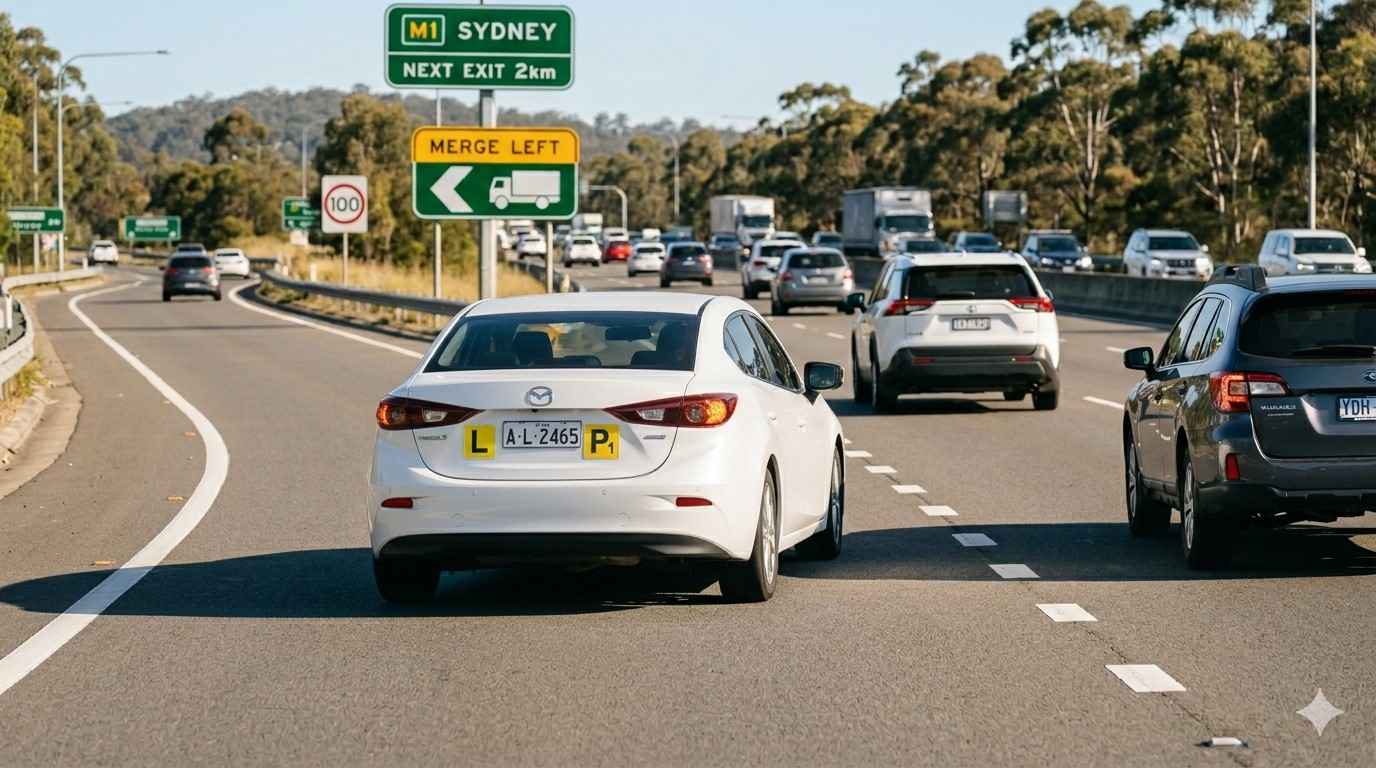
Merging lanes is a fundamental driving skill, yet it is one of the situations that many learner drivers find most challenging. Whether you’re entering a freeway, navigating roadworks, or dealing with a lane closure, merging requires good observation, correct timing, and a clear understanding of Australian road rules.
In this guide, you’ll learn what merging means, how to merge safely step by step, and who gives way when merging. You’ll also understand how zipper merging works and the common mistakes learner drivers should avoid.
Key Highlights
- The safest way to merge is to check your mirrors, signal early, check your blind spot, match the speed of traffic, choose a safe gap, and move smoothly into the lane.
- A zipper merge is a method of combining traffic where two lanes reduce into one, and drivers alternate at the merge point, like the teeth of a zipper. It is designed to keep traffic moving efficiently and reduce congestion, especially in roadworks or lane closures.
- If you are crossing a marked lane line, you must give way to vehicles already in the lane you are entering. If two lanes merge into one without marked lane lines, the vehicle behind gives way to the vehicle ahead.
What Does Merging Mean in Driving?
Merging in driving means joining another lane or stream of traffic safely and smoothly. This usually happens when your lane is ending, when you are entering a motorway or highway from an on-ramp, or when two lanes of traffic need to become one.
Unlike a normal lane change, merging often requires you to adjust your speed, look for a safe gap, and give way when required. For learner drivers, the key is to stay calm, check mirrors and blind spots, signal early, and move into the traffic flow without forcing other drivers to brake suddenly.
Australian Merging Rules Explained
In Australia, merging rules depend on the road markings. If you need to cross a marked lane line, such as a broken line, you must give way to vehicles already in the lane you are entering. This commonly applies when joining a motorway, changing lanes, or moving out of a lane that is ending.
If two lanes of traffic merge into one and there are no marked lane lines, the vehicle behind must give way to the vehicle in front. This is known as a zipper merge, where drivers should take turns and merge smoothly.
For learner drivers, the easiest rule to remember is: if you cross a line, give way; if there are no lines, the vehicle behind gives way.
How to Merge Lanes Correctly?
To merge lanes correctly, check the road ahead, use your mirrors, signal early, check your blind spot, and choose a safe gap before moving across. Adjust your speed to match traffic, merge smoothly without forcing other drivers to brake, then turn off your indicator and keep a safe following distance.
Step 1: Look Ahead and Plan Early
Start by checking the road ahead for lane-ending signs, arrows, traffic lights, roadworks, or vehicles slowing down. Planning early gives you more time to choose a safe gap and prevents sudden, last-minute merging.
Step 2: Check Your Mirrors
Before moving across, check your rear-view mirror and side mirrors. This helps you understand the speed and position of vehicles behind and beside you.
Step 3: Signal Early
Use your indicator to show other drivers that you intend to merge. Signal early enough to give nearby drivers time to react, but remember that indicating does not automatically give you right of way.
Step 4: Check Your Blind Spot
Turn your head briefly to check the blind spot on the side you want to move into. Mirrors do not show everything, and smaller vehicles like motorcycles or bicycles can be hidden beside your car.
Step 5: Match the Speed of Traffic
Adjust your speed so you can merge smoothly with the traffic flow. Avoid merging too slowly or suddenly speeding up aggressively. The goal is to join traffic safely and predictably.
Step 6: Choose a Safe Gap
Look for a gap that gives you enough space in front and behind. Do not force your way into a small gap or make another driver brake suddenly.
Step 7: Merge Smoothly
Move gradually into the lane without swerving or making sudden movements. Keep your steering steady and continue checking the traffic around you.
Step 8: Turn Off Your Indicator and Keep a Safe Distance
Once you have merged, turn off your indicator, maintain a safe following distance, and continue driving at a steady speed.
Ready to become more confident with merging and real-road driving situations?
Book a professional driving lesson today and learn the safe habits you need to drive calmly, confidently, and correctly on Australian roads.
Get StartedMerging in Different Driving Situations
Merging can feel different depending on the road, traffic, and weather conditions. Learner drivers should always plan early, check mirrors and blind spots, signal clearly, and adjust speed smoothly before joining another lane.
1. Merging in Heavy Traffic
In heavy traffic, stay patient and avoid forcing your way into a small gap. Keep your indicator on, move slowly with the traffic flow, and merge when another driver leaves enough space.
2. Merging Onto a Motorway
When merging onto a motorway, use the entry ramp to build speed and match the flow of traffic where safe. Check your mirrors and blind spot, signal early, then merge into a safe gap without stopping unless traffic conditions require it.
3. Merging Near Roadworks
Near roadworks, watch for signs, reduced speed limits, cones, and lane closures. Merge early, leave extra space, and avoid sudden lane changes close to workers or barriers.
4. Merging in Wet Weather
In wet weather, increase your following distance and make slower, smoother movements. Roads can be slippery, so avoid sharp steering, hard braking, or rushing into a gap.
10 Common Merging Mistakes Drivers Make
Most merging mistakes happen because drivers misjudge gaps, fail to match traffic speed, or act too late when entering a lane. By planning early, signalling clearly, and merging at a safe, consistent speed, drivers can avoid these errors and significantly improve road safety.
1. Merging Too Late: One of the most frequent mistakes is waiting until the very end of the lane before attempting to merge. This leaves little time to find a safe gap and often results in sudden or unsafe maneuvers.
2. Driving Too Slowly in the Merge Lane: Some drivers reduce speed too early when approaching a merge, especially on freeways. This creates a large speed difference between their vehicle and traffic in the lane they are entering, making it harder to merge safely.
3. Stopping in a Merge Lane: Stopping in a merge or acceleration lane is dangerous unless absolutely necessary. It can confuse other drivers and increase the risk of rear-end collisions, especially at high-speed entry points like freeways.
4. Not Checking Blind Spots: Relying only on mirrors is a common error. Blind spots can hide motorcycles, cars, or trucks travelling alongside your vehicle. Failing to perform a shoulder check before merging is a major contributing factor in side-impact collisions.
5. Forgetting to Signal Early: Late signalling or not indicating at all reduces predictability and gives other drivers less time to react. Signalling is essential for communicating your intention to merge. However, drivers must remember that indicating does not give the right of way.
6. Misjudging Gaps in Traffic: Choosing a gap that is too small or misreading the speed of approaching vehicles can lead to sudden braking or forcing another driver to adjust. Safe merging depends on accurate judgment of both distance and speed.
7. Forcing Into Traffic: Some drivers attempt to merge by expecting others to slow down or make space. This aggressive approach is unsafe and often leads to frustration or conflict on the road. A safe merge should never rely on other drivers giving way unexpectedly.
8. Assuming Other Drivers Will Let You In: While many drivers are courteous, you should never assume others will create space for you. Legally, the responsibility to merge safely usually rests with the entering or changing vehicle. Planning ahead removes the need to rely on courtesy.
9. Poor Speed Matching: Merging at a significantly different speed from surrounding traffic makes it difficult to slot into a gap safely. Too slow increases rear-end risk, while too fast reduces control. Matching the flow of traffic is essential for smooth merging.
10. Indecisive or Hesitant Merging: Hesitation is just as dangerous as rushing. Unclear movements can confuse other drivers and close off safe gaps. Once a safe gap is identified, merging should be smooth, confident, and predictable.
You may also read: What is a Slip Lane in Australia?
Conclusion
Merging safely in Australia comes down to understanding the rules, staying aware of surrounding traffic, and making smooth, well-timed decisions. Whether you are entering a freeway, navigating roadworks, or dealing with lane closures, the key is to scan early, signal clearly, match traffic speed, and merge into a safe gap without disrupting other road users.
If you want to build these habits more confidently in real-world conditions, structured driver training with a professional instructor from a provider like Nirvana Driving School can help. With guided lessons in real traffic, learners can practice merging, gap selection, and speed control under supervision. This kind of training not only improves safety skills but also prepares you more effectively for passing your driving test. Book your driving lesson today with Nirvana Driving!
FAQs
1. Who has the right of way when merging onto the freeway?
Right-of-way depends on the type of merge. If you are crossing a lane line, entering a freeway, or moving into an already occupied lane, you must give way to vehicles already in that lane. In a zipper merge (where two lanes end and combine), drivers should take turns merging at the merge point in a smooth, alternating flow.
2. Is merging the same as changing lanes?
No. Merging happens when two traffic streams combine, or a lane ends, requiring vehicles to join a single flow. Changing lanes is when a driver moves from one marked lane to another that continues ahead. In lane changes, the driver moving across is responsible for giving way.
3. Do freeway drivers have to let merging cars in?
No, freeway drivers are not legally required to give way to merging vehicles. The responsibility to merge safely lies with the driver entering the freeway, who must find a safe gap without forcing other drivers to slow down or change lanes.